

The Grey Goose story: serving what customers can’t see
>
The Grey Goose story: serving what customers can’t see
In a blind taste test, Grey Goose ranked eighth out of twelve premium vodkas. When the same tasters were asked to rate perceived quality, Grey Goose ranked first. [pawel.ai, 2023]
The product had not changed between the two questions. Only the information had. Without the bottle, the price, the French origin story, and the upmarket placement, the vodka was ordinary. With all of those things restored, it was the best in the room.
Sidney Frank knew this before he made a single bottle. And that knowledge made him two billion dollars.

The problem with vodka
By definition, vodka has no distinctive character, aroma, taste, or color. The European Union’s spirits regulation says so. The United States Alcohol and Tobacco Tax and Trade Bureau says the same. Vodka is, by law, as close to flavorless as fermentation science can produce.
This created a problem for the industry and an opportunity for Frank. In the 1990s, Russian and Scandinavian brands were competing on distillation methods, filtration processes, and water sources. Each claimed their process produced a superior product. The problem was that consumers could not tell the difference. Research confirmed it: the average vodka drinker cannot reliably identify premium from standard in a blind test. When the product cannot be read, the rational buying process breaks down. Sally cannot compare apples with apples because, in this category, all the apples taste the same.
When a customer cannot read quality in the product, they look for quality cues elsewhere.
When competitors fight on ground customers can’t measure
The incumbent vodka brands were locked in a product war. Distillation methods. Filtration processes. Water sources. Each invested heavily in product attributes competitors could not easily copy. The problem was that the customer could not measure any of it.
Run Frictionless identifies this as one of the most important and least understood dynamics in business. There are situations where the value in the product is simply lost on the customer. Not because the product is poor, but because Sally lacks the sophistication to measure it. [Run Frictionless, second edition]
Starbucks baristas slave over grind size, bean origins, milk temperature, and tasting notes. They will tell you today’s roast carries hints of chocolate or citrus if you let it linger on your tongue. Then Sally steps up, listens politely, smiles, and says: “Honestly, I’m here because you’re open at 6am and the Wi-Fi works.” The value in the product is real. Sally simply cannot access it. So she finds value elsewhere.
Insurance is the same. Forty-five percent of Australians will never file a car insurance claim. If Sally never claims, her opinion of the insurer will be shaped almost entirely by how she was served. The policy itself never surfaces. Yet two insurers can spend years competing on policy features and excess structures that Sally cannot evaluate and will never use. They are fighting a product war for a customer who has already stopped listening to the product.
The incumbents who competed against Grey Goose were doing the same thing. They were investing in product attributes the customer could not read. Frank recognized this and stepped out entirely. He stopped competing on the product and built his entire advantage in his story, his target customer, and his experience. He targeted the right early adopters. He built a French origin story the customer could see, feel, and repeat to friends. He placed the product where the right people would be seen holding it. And he priced it double the market leader, because price itself is a quality cue when the customer cannot judge quality any other way.
There is a further trap that Run Frictionless calls out directly. When margins are under pressure, the instinct is to go back to the product. Improve the features. Add a new attribute. Justify a price increase through a better specification. But this is expensive, slow, and carries no guarantee. If Sally cannot measure the improvement, she will not pay more for it. The extra investment disappears into a product the customer cannot evaluate.
A faster and more defensible path to a price increase is to invest in the story and the experience. Sally will pay more for a product she trusts and feels something about, long before she will pay more for a feature she cannot assess. [Run Frictionless, second edition]
When the product has become a battlefield where all competitors look the same, the coach’s job is to help the client see it. The product improvements are costly. The customer may not even notice the difference. A faster way to build a defensible position and justify a higher price is to invest in brand and experience instead.
This is where a framework called 4Q becomes useful.
4Q is introduced in Run Frictionless. It groups everything in a business into four quadrants. Q1 is who we serve: the ideal customer. Q2 is what we serve: the product or service. Q3 is who we are: the brand, the belief, the identity, the story the business tells about itself. Q4 is how we serve: the customer experience, every touchpoint that shapes how the customer feels before, during, and after a transaction.
In most businesses, Q2 receives the most attention. Leaders invest in the product. They refine it, improve it, and price it carefully. This is rational. But when the customer cannot measure the value of Q2, something shifts. The investment in Q2 stops returning results. And the quadrants that carry the weight become Q3 and Q4.

Who we are becomes more important than the product
This is what Run Frictionless calls irrational buying forces. Q3 and Q4 shift the buying decision away from checklists and pricing tables toward something the customer feels rather than calculates.
In Q3, the force works like this. When a brand’s story, values, and identity speak directly to who Sally is, she experiences something close to relief. Someone finally gets me. Someone finally understands me. That feeling of being seen is not rational. It cannot be measured on a spreadsheet. But it is extraordinarily powerful, and it is a quality cue. If this brand understands me this well, their product must be right for me too.
In Q4, the force works differently but produces the same result. When Sally is served quickly, smoothly, and with care, she draws a conclusion about the product she has not yet fully evaluated. If they serve me this well, imagine how good the product must be. The experience becomes a proxy for product quality. Run Frictionless describes this as the halo effect: excellence in how you serve colors Sally’s judgment of what you serve.
Harvard Business School professor Gerald Zaltman has found that up to 95 percent of purchase decisions occur subconsciously. Stanford neuroscientist Baba Shiv found that the rational mind accounts for just 5 to 10 percent of decision-making, while the emotional mind governs the rest. [Run Frictionless, second edition]
When the customer cannot read the product, the emotional mind does almost all the work. Q3 and Q4 become the product. And they are far more defensible.
How Frank used all four quadrants
Frank did not compete in Q2. He accepted that the product was indistinguishable and built his entire strategy in the other three quadrants.
In Q1, he targeted early adopters: doctors, professionals, and tastemakers who would be the first to pay a premium price and set a trend for others to follow. He was not selling to everyone. He was selling to the people whose choices would be copied.
In Q3, he built an origin story that Q2 could never deliver on its own. France. French winter wheat. Spring water filtered through Champagne limestone. A cellar master hired from the cognac industry. The bottle, a long-necked frosted design that communicated elegance on sight. None of this changed the liquid. All of it changed what the liquid meant.
In Q4, he placed Grey Goose exclusively in upscale bars, hotels, and restaurants where celebrities dined. He did not sell it in supermarkets. He controlled where it was seen and who was seen holding it. The price was set at thirty dollars a bottle, double the market leader. The price itself was a quality cue. If it costs that much, it must be that good.
By 2000, Grey Goose was selling 1.5 million cases annually. In 2004, Bacardi acquired it for approximately two billion dollars. Seven years. Two billion dollars. Built almost entirely on Q3 and Q4. [Grokipedia, 2026]
Where the product is opaque in your clients’ businesses
The client who receives a set of accounts from their accounting firm cannot judge whether the work is good. They lack the training. They sign off on the figures and trust that the numbers are right. The business owner who commissions a copywriter cannot assess whether the copy they received is the best it could have been. They read it, approve it, and publish it. The patient who undergoes surgery cannot evaluate whether the technique was optimal. They recover and assume it went well.
In all of these situations, the product has been delivered. The customer simply cannot judge it.
This is not a failure of the customer. It is the nature of the category. And it has a direct commercial consequence. If Sally cannot judge the product, she cannot use it to justify paying more. She cannot use it to explain to a friend why one firm is better than another. She cannot use it to build loyalty. So she builds her judgment on what she can assess: how the firm made her feel, what the brand stood for, and whether the experience of working with them was frictionless.
This is the question to put to every client: after Sally has received what she paid for, can she actually judge its quality? If the answer is no, the brand and the experience are not supporting the product. They are the only things she has to go on. And they need to be invested in accordingly.
Q3 and Q4 are defensible. Q2 often is not.
There is a second lesson in the Grey Goose story that coaches should not miss.
Absolut had a better product by most measures. It was established, well-distributed, and genuinely well-made. But its competitive advantage was in the product. And product advantages are copyable. A competitor can always improve their distillation process, source better water, or hire a better technical team. Product advantages erode.
Q3 and Q4 are harder to copy. A brand story built over years is not replicable overnight. A placement strategy that has made your product synonymous with a particular lifestyle takes time and money to displace. A customer experience that makes Sally feel seen, served, and confident creates loyalty that a product specification cannot match.
When Frank flew above Absolut rather than fighting it, he was not avoiding a fair fight. He was choosing a more defensible position. He was building equity in the quadrants that competitors could not simply copy by improving their recipe.
For coaches, this reframes where investment belongs. Most clients will instinctively invest in the product. It is tangible. It feels safe. But in categories where the product is opaque or commoditized, the highest-return investment is often in Q3 and Q4. The story. The experience. The quality cues that do the work the product cannot.

start using
4Q
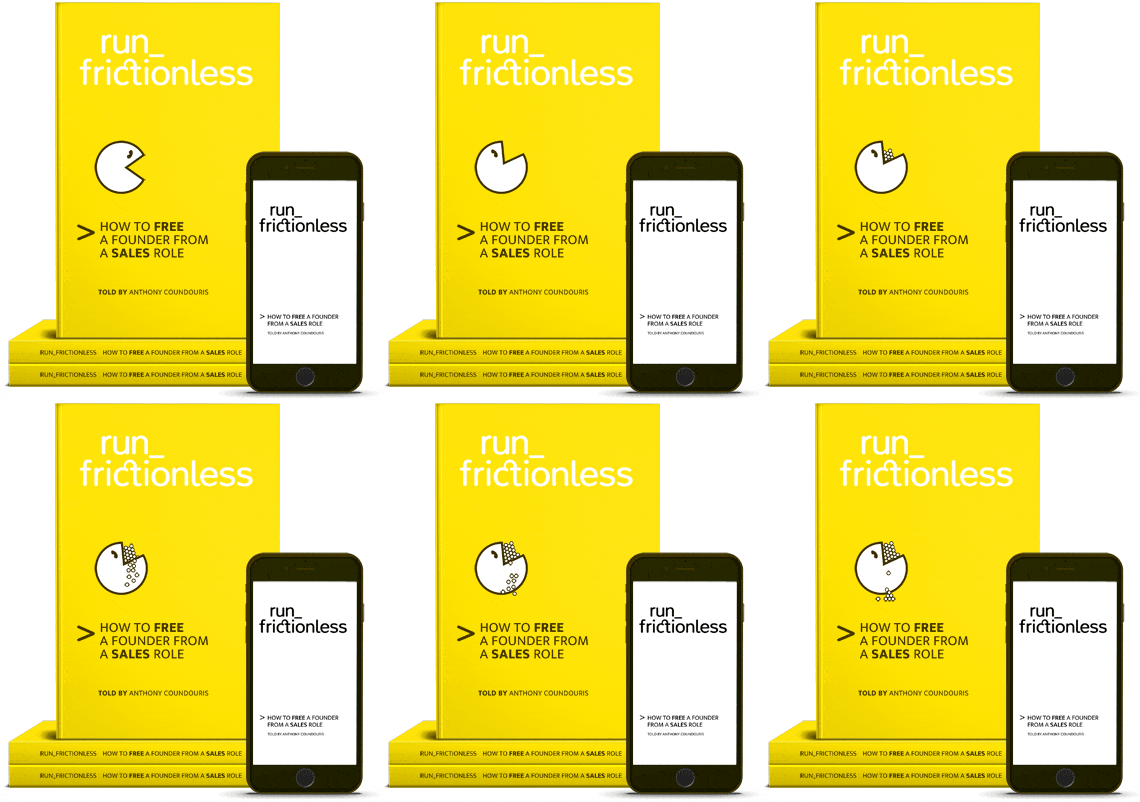
Run Frictionless second edition gives coaches and founders a practical framework for building businesses that scale. It explores irrational buying forces in depth: where they operate, how to harness them, and how to build equity in the quadrants that competitors cannot easily replicate. Every purchase includes a free playbook and an online session with the author.
References
pawel.ai (2023). The marketing phenomenon behind Grey Goose vodka. pawel.ai
Luxury Life Guide (2026). Premium vodka blind taste test analysis. viajerox.mx
Grokipedia (2026). Grey Goose (vodka). grokipedia.com
Choice Hacking (2023). How Grey Goose used psychology to become a $4B brand. choicehacking.com
Adweek (2018). How Grey Goose made Americans realize that the taste of vodka matters. adweek.com
Run Frictionless, second edition. Anthony Coundouris. amazon.com.au/dp/B0H4SB1RKG

