

The Reece story: why customer experience beats product every time
>
The Reece story: why customer experience beats product every time
Most business owners believe that if they have a good product, their job is done. Get the product right, and customers will come. Keep the product stocked, and customers will return. This is one of the most common and most costly assumptions a business can make.
Reece is the Australian case study that proves otherwise. The Melbourne-based plumbing and bathroom supplier has grown from a single store in Caulfield to a nine billion dollar global business, not by selling better pipes than its competitors, but by investing relentlessly in how those pipes are sold, delivered, and experienced. The Wilson family, who have controlled Reece for more than five decades, built one of Australia’s great businesses on a simple insight: the product is only half the job.

How it started
In 1920, Harold Joseph Reece began selling hardware supplies from the back of his truck in Victoria. Later that year he opened the first H.J. Reece store in Caulfield, built on what the company describes as exceptional tools and expert advice. [Reece Group, Our Story]
The business was listed on the ASX in 1954. In 1969, on the same day that humans first stepped onto the moon, the Wilson family became majority shareholders. [Reece Group, Our Story] Alan Wilson became CEO in 1970, merged his own venture Austral Hardware with Reece, and spent the next four decades transforming a regional hardware supplier into Australia’s largest plumbing distributor. His son Peter Wilson became CEO in 2008. Three generations of the same family. One consistent philosophy: put the customer at the center of everything.
Today Reece operates more than 800 branches across Australia, New Zealand and the United States, employs approximately 9,000 people, and holds an estimated 45 percent share of the Australian plumbing distribution market. [MatrixBCG, 2026] Revenue in 2025 reached nine billion dollars.
The bricklayer problem
Run Frictionless introduces a bricklayer named Tom. Tom is exceptional at his trade. He knows white bricks, bullnose bricks, stacked bricks, half bricks, sand-stock bricks, convict bricks. Ask him about mortar ratios and he will talk for an hour.
Sally hires him to build a wall. Tom comes to inspect the job and the conversation goes well. Then Sally asks when he can start. Tom mentions he has a footy game and piano lessons to work around before he can commit to a date. Sally feels like she is serving him. Saturday comes and she forgets to call him back. By Sunday, she has forgotten how good his bricklaying is. All she can think about is finding someone who can keep an appointment.
Tom has invested everything in what he serves and nothing in how he serves. His response captures it perfectly:
The product is impeccable. The experience around it is invisible. And it is costing him work.
This is the trap most business owners fall into. They pour energy into the product and leave the experience to chance. What they serve and how they serve are treated as one thing when they are two very different assets, each requiring its own investment and its own standard of care.
Reece understood this distinction earlier and more deeply than almost any other Australian business. And it made them dominant.
Investing in Q4: the retail experience
In 1986, Reece introduced complete bathroom and kitchen displays to its stores. [Reece Group, Our Story] It was a first for Australian showrooms. At the time, the plumbing trade was a counter business: you walked in, named your part, and walked out. Reece saw that the tradesperson’s customer, the homeowner ordering a bathroom renovation, needed something different. They needed to see, touch, and imagine.
By separating the trade counter from the showroom, Reece created two distinct experiences under one roof. The tradesperson got speed, stock availability, and expert advice. The homeowner got a premium retail environment. Both felt served. Neither felt like they had walked into the wrong room.
In the 4Q framework, this is the difference between Q2 and Q4. Q2 is what we serve: the product itself. Q4 is how we serve: the experience, the journey, every touchpoint that shapes how the customer feels before, during, and after the transaction. Reece did not change what they sold in 1986. They redesigned how they sold it. That is a Q4 decision. And it separated them from every competitor who was still running a counter business.
This model, what Reece now calls Reece Plumbing for the trade and Reece Bathroom Life for premium retail, captures two very different customer types and serves each of them in a way that speaks directly to who they are. For each of them, buying from Reece is frictionless.
There is another reason the Wilson family’s investment in how they serve was so powerful. It tapped into something most business owners never consider.
When Sally is choosing a plumbing supplier, she compares product range, price, and availability. She makes a list. She weighs features. She applies logic. This is what she does in Q2. It is rational buying.
Q4 shifts the decision somewhere else entirely. Harvard Business School professor Gerald Zaltman has found that up to 95 percent of purchase decisions occur subconsciously, driven by forces that have nothing to do with features or price. Stanford neuroscientist Baba Shiv found that the rational mind accounts for just 5 to 10 percent of decision-making, while the emotional mind governs the rest. [Run Frictionless, second edition]
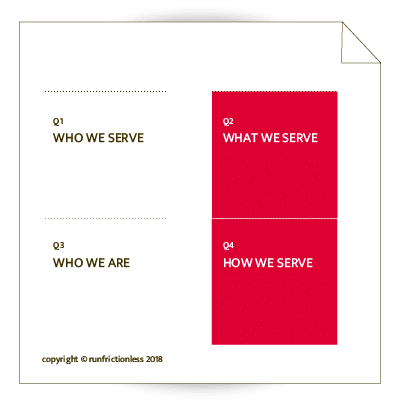
Rational and irrational buying forces
This is what Run Frictionless calls irrational buying forces. When Sally walks into a Reece showroom and sees a beautifully staged bathroom, she is not comparing pipe specifications. She is imagining her home. She is feeling something. That feeling is Q4 at work.
The plumber who opens the maX app and places an order in two minutes instead of twenty is not making a rational decision to stay loyal to Reece. He is making an emotional one. Reece has made his day easier. That feeling compounds over time into something competitors cannot easily replicate: trust.
Coaches who help clients invest in Q4 are not helping them improve a process. They are helping them build the emotional equity that keeps customers coming back long after a competitor has matched the product or the price.
The maX app: Q4 in the digital age
The showroom was the first generation of Reece’s Q4 investment. maX is the second.
maX is a B2B trade app developed exclusively for Reece account customers. It allows tradespeople to search products, check real-time local stock, place orders, manage their account, generate customer quotes, and track deliveries, all from their phone, on site, in the ute, or back at the office. [Reece, Online Tools and Services]
The redesign of the maX app, led in partnership with Melbourne design studio Relab, was built around a single goal: make ordering frictionless — so easy, accessible, and transparent that using the app would eventually be simpler than walking into a branch. [Relab Studios, 2024] The research phase involved user testing, analytics review, and direct customer interviews to identify friction points in the previous version.
Reece also introduced Imagin3D, a 3D bathroom planning tool developed with Thoughtworks that lets customers pick products, visualize the finished result, and make decisions with confidence before a single tile is laid. [Thoughtworks, 2024] It is used by showroom consultants, tradespeople, and homeowners alike to close renovation contracts.
Beyond the app, Reece has built an ecosystem of integrated services: FieldPulse for job management, Laddr for trade finance, and direct integrations with quoting tools like FlatRateNOW and Ascora. The plumber who uses Reece is not just buying pipes. They are buying a platform that makes their entire business easier to run.
What coaches can take from this
Most business owners think of what they sell and how they sell it as the same thing. They are not. When asked what their business does, a business owner will describe their product or service. Rarely will they describe the experience around it. And so how they serve goes unexamined, underinvested, and undervalued.
In the language of Run Frictionless, this is the muddle between Q2 and Q4. Q2 is the product. Q4 is the experience. Each requires its own investment, its own strategy, and its own standard of care. A business that improves its product every year but never improves its experience is leaving equity on the table.
Most clients a coach works with have invested in their product. They have refined it, improved it, and priced it carefully. What they have not done, in most cases, is think equally hard about how that product is served.
They have not mapped the journey Sally takes from first contact to final delivery. They have not asked which moments are adding friction and which are adding trust. They have not worked out what Q4 is actually worth to the business.
The Reece story gives coaches a powerful illustration of what Q4 investment looks like at scale. Reece did not dominate the Australian plumbing market by selling better pipes. Their competitors had access to the same pipes. They dominated by making it easier, faster, and more pleasant to buy from them than from anyone else. The showroom. The trade counter. The maX app. The Imagin3D tool. The financial services. Each one is equity invested in Q4, not Q2.
The question to put to every client is this: if a competitor offered the same product tomorrow at the same price, would your customers still choose you? If the answer is yes, the experience is frictionless and Q4 is working. If the answer is not certain, the business is more fragile than it looks.
Reece has been investing in Q4 since 1920. It is why they hold 45 percent of the Australian plumbing market. And it is why Tom the bricklayer is still waiting for the phone to ring.

start using
4Q
Run Frictionless second edition gives coaches and founders a practical framework for building businesses that scale. It explores the relationship between Q2 and Q4 in depth: what it means to serve a product well, and what it takes to serve the experience that surrounds it. Every purchase includes a free playbook and an online session with the author.
Acknowledgement
This post was inspired by the work of Cam at Infinite Ltd, an Australian YouTube channel dedicated to telling the stories of the businesses and brands that shape our world. His video on Reece and the Wilson family is well worth your time.
You can find Cam’s channel at youtube.com/@InfiniteLtd and his production company at frontiermediaco.com.
References
Reece Group. Our Story. group.reece.com/who-we-are/our-story
Reece Group. Innovation. group.reece.com/what-we-do/innovation
Reece. Online Tools and Services. reece.com.au/online-tools-and-services
Relab Studios (2024). Reece Group: B2B maX App — Design Sprint and UX/UI Design Strategy. relab.com.au
Thoughtworks (2024). Digital innovation in interior design: Transforming Reece’s operations. thoughtworks.com
MatrixBCG (2026). What is Sales and Marketing Strategy of Reece Company. matrixbcg.com
Wikipedia. Reece Group. en.wikipedia.org
Campden FB (2014). Australian family business profile: Reece. campdenfb.com
Infinite Ltd (2025). Reece: How a Family Built Australia’s Plumbing Empire. youtube.com/@InfiniteLtd


