
When buyers don’t share the belief: Dick Smith story
>
When the buyer doesn't share the belief: the Dick Smith story
Dick Smith Electronics was not just a retail chain. It was a belief made physical. The belief that electronics should be accessible, affordable, and genuinely exciting for the curious and the hands-on. That belief was the business. It shaped who the stores served, what they sold, how staff talked to customers, and why millions of Australians felt at home the moment they walked through the door.
In 1980, Dick Smith sold 60 percent of his company to Woolworths. By 1982, Woolworths owned it entirely, paying a total of 25 million dollars. On paper, it was a sensible acquisition. In practice, it was the beginning of a slow and irreversible identity crisis.

What Dick Smith built
Dick Smith started in 1968 with 610 dollars and a car radio installation business beneath a Sydney car park. By 1980 he had grown it to 20 stores, built on a simple and powerful idea: serve the hobbyist. [SmartCompany, 2019]
In those days, electronics enthusiasts had nowhere to go. Wholesale suppliers were set up for commercial customers, not weekend tinkerers. Dick Smith created a self-serve retail environment where hobbyists could browse components, buy kits, and get advice from staff who shared their passion. The store was a playground. Its customers were loyal not because they had to be, but because they believed in what the brand stood for.
That belief was the business. Dick Smith himself was its embodiment. His face was on the logo. His voice was in the catalogue. His curiosity and enthusiasm were the brand’s personality. When he sold to Woolworths and walked away in 1982, the face remained. The belief began to erode.
What Woolworths brought
Woolworths was a mass-market retailer. Its strengths were volume, range, and efficiency. It knew how to run large-format stores, manage high-turnover inventory, and serve the broadest possible customer base. These are genuine and valuable capabilities. But they are not the capabilities of a business built to serve hobbyists.
Under Woolworths, Dick Smith shifted from a specialist chain emphasizing components for electronics enthusiasts to a mass-market consumer electronics retailer. Televisions. Audio equipment. Budget laptops. GPS units. Microwaves. The products changed because the customer changed. Woolworths was not serving the hobbyist. It was serving everyone. As Adam Insights observed in 2025, the stores were drifting from enthusiast paradise to general electronics chain, and in trying to be more like JB Hi-Fi, losing what made them special.
The stores expanded. Revenue grew. At its peak, Dick Smith under Woolworths generated 1.4 billion dollars in annual sales. [Wikipedia, Dick Smith businessman] But the brand’s distinctive quality had been systematically replaced by generic electronics retail. Competitors like Jaycar, Altronics, and Leading Edge filled the hobbyist vacuum that Dick Smith had abandoned. The customers who had been most loyal to the brand had nowhere to go inside it anymore.
The psychology that balance sheets miss
When Woolworths acquired Dick Smith, the due diligence covered the financials. What it could not capture was the psychology.
The operations teams that Woolworths brought to serve Dick Smith stores were not Dick Smith people. They did not share the passion for electronics. They had not spent weekends building kits or hunting for components. They could not empathize with the customer standing at the counter wanting to know which capacitor would work in a vintage amplifier. In the language of Run Frictionless, they could not be Sally-centric, because they did not understand Sally.
Staff and customers are two sides of the same coin. When the organization asks staff to serve a customer they cannot empathize with, friction is felt twice: externally by the customer and internally by the team. The cashier who cannot answer the question, the store manager optimizing for throughput rather than conversation, the operations executive designing processes for a supermarket customer, not a hobbyist. All of them adding friction, not because they are incompetent, but because the customer in front of them is not the customer they were built to serve.
There is a phrase that captures this dynamic with uncomfortable precision:
It is not laziness. It is the natural response to a misalignment between who the organization hired and who the customer expects to be served by.
When that misalignment becomes systemic, it creates what psychologists call cognitive load: too much complexity and irrelevant demand competing with the information a person needs to process. Staff disengage. They stop asking questions. They go through the motions. The customers who needed more than a transaction, who came for the conversation, the advice, the shared enthusiasm, stop coming back.
Research confirms the pattern. A study cited in the International Journal of Research and Public Reviews found that process friction and misalignment were cited as primary reasons for 67 percent of voluntary departures. The best staff leave first. The ones who remain are those with nowhere better to go.
This is the psychology the balance sheet does not capture. The Woolworths acquisition looked right on paper. But paper cannot measure whether the people serving Dick Smith customers actually wanted to.
Dick Smith under its founder was a curiosity store. You went in not always knowing what you would find. There were kits to build, components to browse, gadgets to examine, and staff who wanted to talk about all of it. The experience was an expression of the belief: electronics is exciting, accessible, and worth exploring.
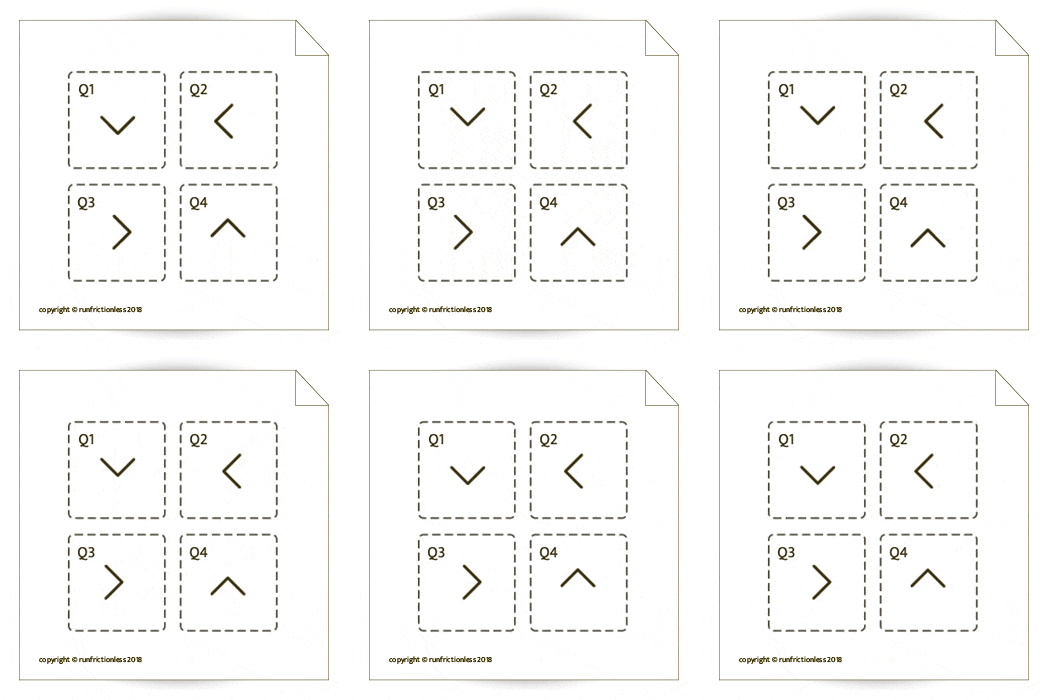
In the 4Q framework, Q3 is who we are: the belief, the identity, the values that shape how an organization presents itself to the world. Q4 is how we serve: the customer experience, the journey, the moments that determine how a customer feels at every touchpoint. These two quadrants are not independent. Q3 defines the spirit of the experience. Q4 delivers it. When the belief in Q3 erodes, the experience in Q4 follows.

When the belief changes, the experience follows
This is exactly what happened at Dick Smith under Woolworths.
As the belief shifted from hobbyist passion to mass-market efficiency, the store changed around it. The kits disappeared. The components shrank to a single rack near the back. The layout became standardized. The iconic man-with-glasses logo was eventually dropped. Staff were hired for general retail competence, not electronics knowledge. The conversations that once made the store worth visiting stopped happening.
What replaced them was a generic electronics retail experience. Bright lighting. Boxed products on shelves. A checkout. There was nothing wrong with it. It just wasn’t Dick Smith.
The customers who walked in looking for a curiosity store found a commodity store. And commodity stores are easy to leave. There is always another one nearby with a better price, a wider range, or a faster delivery. The loyalty that the original Dick Smith had earned evaporated alongside the experience that had created it.
Woolworths understood logistics. What it did not understand was that the Dick Smith experience was not a retail format. It was a belief, made physical, one store at a time.
The belief gap
In the 4Q framework, a business’s identity and beliefs sit in the third quadrant. Who we are. What we stand for. The values that connect the organization to the customers it serves and the staff who deliver the experience.
When the belief in Q3 aligns with the customer in Q1, something powerful happens. Customers don’t just buy the product. They belong to something. They recommend it. They return without prompting. They pay full price because the brand speaks to who they are.
Dick Smith Electronics had that alignment. Woolworths did not share the belief. And so the acquisition, while financially logical, created a belief gap that widened with every decision made in the interests of mass-market efficiency rather than hobbyist passion.
This is what happens when the buyer does not share the belief. The brand name survives. The belief does not. And without the belief, the customers who were most loyal begin to drift.
When belief doesn't transfer
The Dick Smith story is not unique. The pattern repeats whenever an acquisition is evaluated on financial terms alone, without asking whether the acquiring organization shares the belief of the business being bought.
When Ben and Jerry’s was acquired by Unilever in 2000, the founders feared exactly this outcome. Their brand was built on a belief in social activism, environmental responsibility, and non-conformity. Unilever was a global consumer goods conglomerate. The acquisition included unusual contractual protections designed to preserve the brand’s mission. Without them, the belief would have been absorbed and neutralized within years.
The same tension plays out at every scale. A boutique accounting firm acquired by a national network. A family-owned manufacturer absorbed by a private equity roll-up. A values-driven technology startup bought by a corporate. In each case, the question that is rarely asked clearly enough at the time of the transaction is: does the buyer share what we believe?
If the answer is no, the customers will eventually notice. Staff will feel it first. Then the culture shifts. Then the customers drift. Then the numbers follow.
The three outcomes of sharing a belief
Run Frictionless identifies three outcomes when a business shares its belief with those around it: acceptance, indifference, and hostility.
Acceptance is what Dick Smith Electronics had under its founder. Staff shared the belief. Customers shared it. The hobbyist community felt seen. Everyone in the room was playing the same game.
Indifference is what arrived with Woolworths. The mass-market grocery culture did not engage with the hobbyist belief. It was not hostile. It was blank. Woolworths applied its own operational playbook, and the Dick Smith belief faded by neglect rather than by deliberate intent. Where hostility may well have existed beneath the surface, it was likely a natural consequence of people who simply did not share the same belief being asked to serve those who did.
Hostility is the most visible and most damaging outcome. It arrives when two parties with opposing beliefs are forced to coexist inside the same organization. The Foster’s acquisition of Southcorp in 2005 is the Australian case study.
Foster’s was built on volume and accessibility. It sold beer to everyone. Its belief was democratic: cold, reliable, affordable, and everywhere. Southcorp was built on prestige and craft. It was the custodian of Penfolds, Lindemans, and Rosemount, brands that sold provenance, patience, and connoisseurship to buyers who read tasting notes and cared which valley the grapes came from. One culture sold beer at a football match. The other sold wine at a restaurant. The two beliefs could not have been more different.
Foster’s used one sales force to sell both. The same people who called on bottle shops with VB were now expected to walk into fine dining establishments and talk terroir. The beer people did not understand the wine world. The wine people did not respect the beer culture. One commentator described the brewery executives who oversaw the combined entity as barbarians. It took fourteen years for Foster’s to acknowledge what everyone inside already knew: while beer and wine are both alcoholic, there are few other similarities between their manufacture, marketing, or distribution. Foster’s lost approximately 3.5 billion dollars on its wine ventures before spinning the division off in 2011.
This is what hostility looks like inside an organization. It is not dramatic. It does not announce itself. It arrives as eye-rolls in meetings, talent walking out the door, and a slow corrosion of the thing that made the acquired business worth buying in the first place.
In the 4Q framework, the alignment between Q1 (who we serve) and Q3 (who we are) produces scale. When that alignment breaks down, the reverse is also true. Misalignment between who is being served and what the organization believes produces drag. Internal friction mounts. The best people leave. The culture fractures along the fault line between two beliefs that were never compatible to begin with.
For coaches working with clients who have recently acquired, merged, or partnered with another organization, the question is not whether the numbers stack up. It is which of the three outcomes is already underway.
What this means for coaches
When a client is considering acquisition, partnership, or distribution through a third party, the financial analysis rarely captures the belief gap. Coaches can add significant value by asking the questions that due diligence typically misses.
Does the acquiring organization serve the same customer? Do they share the same beliefs about how that customer should be treated? Will the staff who built the culture survive the transition? Will the brand’s most loyal customers recognize themselves in what the business becomes?
These are not soft questions. They are the questions that determine whether an acquisition creates lasting value or simply transfers a name to a company that no longer knows what it stands for.

buy the
book now
Run Frictionless second edition gives coaches and founders a practical framework for building businesses that scale. It explores belief fit in depth: what it means to align who you serve with who you are, what happens when that alignment breaks down, and how to ask the questions that financial due diligence misses. Every purchase includes a free playbook and an online session with the author.
Acknowledgement
This post was inspired by the work of Cam at Infinite Ltd, an Australian YouTube channel dedicated to telling the stories of the businesses and brands that shape our world. His video on the rise and fall of Dick Smith Electronics is well worth your time.
You can find Cam’s channel at youtube.com/@InfiniteLtd and his production company at frontiermediaco.com.
References
SmartCompany (2019). The timeline of Dick Smith: From humble beginnings to $520 million float and voluntary administration. smartcompany.com.au
SmartCompany (2012). Dick Smith’s $400 million fall: Five ways an icon stumbled. smartcompany.com.au
The Conversation. The ugly story of Dick Smith, from float to failure. theconversation.com
Dynamic Business (2012). Woolworths cuts Dick Smith loose. dynamicbusiness.com
Dick Smith (2024). About Us. dicksmith.com.au
Adam Insights (2025). From nerd heaven to collapse: the full story of Dick Smith Electronics. adaminsights.com
Wikipedia. Dick Smith (businessman). en.wikipedia.org
Crikey (2010). Foster’s investors say cheers to beer-wine split. crikey.com.au
BestWinesUnder20 (2011). How Southcorp and Foster’s trashed Australia’s greatest wine brands. bestwinesunder20.com.au


