If you like product–market fit, you’ll love 4Q
>
If you like product–market fit, you'll love 4Q
When Marc Andreessen coined the term product–market fit, it landed like a light bulb moment for a generation of founders and coaches. He reframed the work of building a business: not as a tidy sequence of steps, but as a nonlinear search for alignment between a product and the people who need it most. For many of us, it was the first time the chaos of early-stage business had a name.
But as a business coach, product–market fit always felt too broad. One stroke across the whole canvas. It tells you that alignment exists, but not where, or between what. It describes a moment. It doesn’t give you a map.
Run Frictionless builds on Andreessen’s metaphor and takes it further.

What is 4Q?
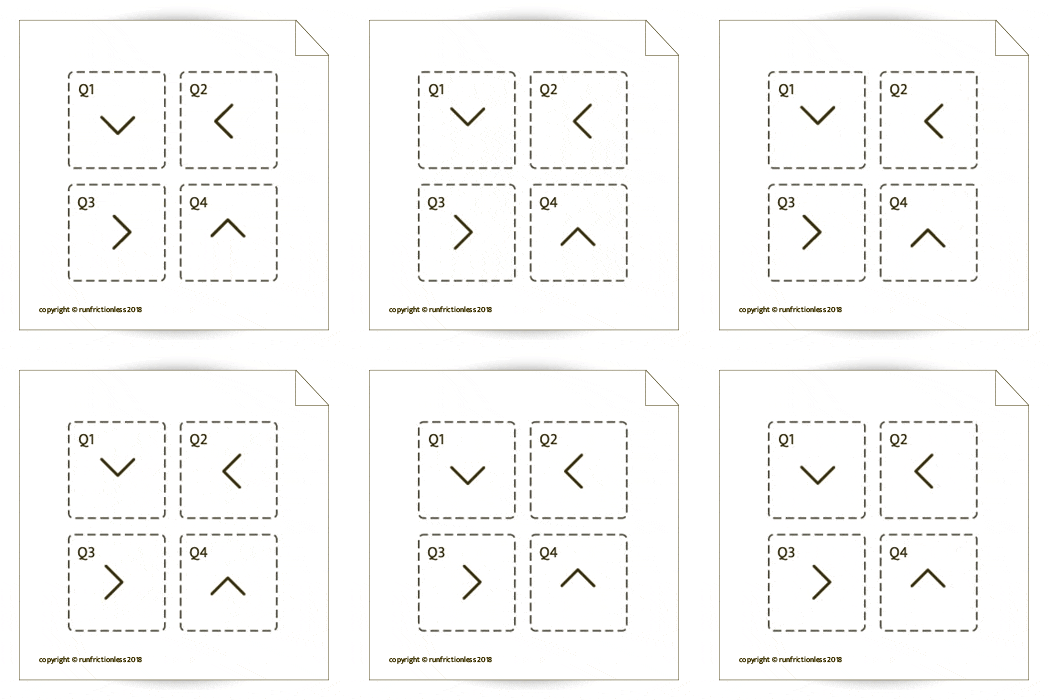
4Q is a decision-making framework. It examines how value is created in a business and groups that value into four quadrants. Every person, process, and task in a business belongs in one of them.
Think of it like a four-cylinder engine. Most businesses run on two cylinders. They’ve invested in two of the quadrants and left the other two on the table. Competitors move into the gaps. 4Q helps coaches and their clients see the whole engine, and work on all four cylinders at once.
-
💬
- product–market fit was a light bulb moment. But for coaches working with clients every day, it wasn’t granular enough.
No quadrant works alone. The real power of 4Q lies in how quadrants fit together. A fit is the alignment between two quadrants that produces a measurable result. It is what you and your client are working toward in every engagement.
Run Frictionless identifies six fits in total. The first three are the ones every coach needs to master.
One fit produces revenue.
One fit produces scale.
One fit produces growth.
What coaches get that founders don't
Product–market fit describes a single moment: the point at which a product and a market align and demand begins to grow. It is enormously useful. But it only covers one relationship: between what your client sells and who buys it.
As a coach, you need more than that. You need to know which fit is missing. You need to know whether your client is generating revenue but can’t scale, or scaling but not growing. You need a vocabulary precise enough to name the problem in the room.
The three fits give you that vocabulary.
Striking a fit is not linear
Striking a fit is more like repairing an antique chair than following a set of instructions. You fashion a new arm, try to fit it, shave a little off one end, check the other, adjust again. Back and forth between customer and product until both ends meet cleanly. It takes as long as it takes: three months or three years.
As a coach, you already know this. The most important work you do with a client is never linear. The fits give that work a shape.
Dyson, Apple, Canva, and Starbucks
Dyson, Apple, Canva, and Starbucks share one thing: they removed barriers and created remarkable brands. Each of them, whether they knew it or not, struck all three fits. They aligned who they served with what they sold, built a brand those customers believed in, and designed an experience that kept them coming back.
Your clients can do the same. Run Frictionless shows you how to help them get there.

buy the
book now
The three fits are introduced here, but the detail: how to strike each one, how to teach it to a client, and how to track whether it’s working, is in Run Frictionless. Every purchase includes a free playbook and an online session with the author.